


AI Hallucination Examples (2026): Real Stories, Hard Lessons, and How to Stay Safe
The Quick Answer
Table Of Content
- I Trusted an AI’s Answer. It Almost Cost Me Everything.
- What Is an AI Hallucination?
- Hallucination vs. Error: Understanding the Difference
- Real Stories: When Hallucinations Cost Millions
- The Legal Case That Changed Everything
- Medical: When Confidence Becomes Dangerous
- The Startup That Almost Hired a Fake Person
- Why This Keeps Happening: The Technical Reasons
- Reason 1: Next-Token Prediction Doesn’t Verify Facts
- Reason 2: Parametric Memory Has Gaps
- Reason 3: Training Data Has a Cutoff
- Reason 4: Long Conversations Degrade Accuracy
- Reason 5: Vague Prompts Invite Vague (or Wrong) Answers
- Across Industries: Who’s Most Vulnerable?
- Healthcare: The Highest Risk
- Legal Services: Where One Wrong Citation Ruins Careers
- Software Development: Package Hallucination Attack
- Scientific Research: Citations That Go Nowhere
- Business: The Policy That HR Never Wrote
- How to Detect Hallucinations Before They Cost You
- Verification Strategy 1: Check Citations Like Your Life Depends On It
- Verification Strategy 2: Use Official Sources, Not AI Summaries
- Verification Strategy 3: Use Multiple Independent Sources
- Verification Strategy 4: Test Generated Code Rigorously
- Verification Strategy 5: Notice Suspiciously Round Numbers
- What Actually Works: Proven Solutions
- Solution 1: Retrieval-Augmented Generation (RAG)
- Solution 2: Knowledge Grounding
- Solution 3: Structured Outputs
- Solution 4: Mandatory Human Review
- Better Prompts, Better Results
- Specific Techniques That Help
- The Hallucination Landscape in 2026
- Which AI Models Hallucinate Most?
- Hallucination Risk by Model (2026 Data)
- Protecting Yourself: Action Checklist
- Daily AI Safety Practices
- Industries Most At Risk
- Critical Risk (Mistakes Could Kill)
- High Risk (Mistakes Could Cost Serious Money)
- Moderate Risk (Mistakes Could Spread)
- The Future: Are Hallucinations Avoidable?
- The Real Lesson
- Your Action Plan: Three Steps
- Verify What Matters:(Step 1)
- Trust But Check:(Step 2)
- Remember the Core Principle:(Step 3)
- Frequently Asked Questions
- Q: What is the most famous real example of an AI hallucination?
- Q: Why do AI models hallucinate even when they seem confident?
- Q: Which industries face the highest hallucination risk?
- Q: Does Retrieval-Augmented Generation eliminate hallucinations?
- Q: How do I reduce hallucinations in my own AI use?
- Q: Can I trust Claude/GPT more than other models?
- Key Takeaways
- About the Author
- Sources & References
- Ready to Protect Yourself?
AI hallucinations occur when language models generate confident but false information. They happen because models predict likely words rather than verify facts. The best defenses are retrieval-augmented generation (RAG), source verification, and human review.
I Trusted an AI’s Answer. It Almost Cost Me Everything.
A software developer I know — let’s call him Tariq — spent three days building a payment integration for his startup. He used an AI assistant to speed up the work. The code looked clean. The logic made sense. The API endpoints were documented with perfect clarity.
There was just one problem.
The API didn’t exist.
The AI had invented every method, every parameter, every configuration flag — completely fabricated. Tariq only discovered this the night before his client demo, when nothing worked and the real documentation had no record of it.
He’s not alone.
The immediate impact? A missed deadline. Client trust is damaged. Three days of wasted work. But more importantly, Tariq learned something critical: a fluent answer is not the same as a correct answer.
What Is an AI Hallucination?
In 2026, AI hallucinations have moved from being a quirky curiosity to a genuine professional hazard. They’ve derailed legal cases, introduced errors into medical advice, created security vulnerabilities in software, and caused real people to make decisions based on information that wasn’t true.
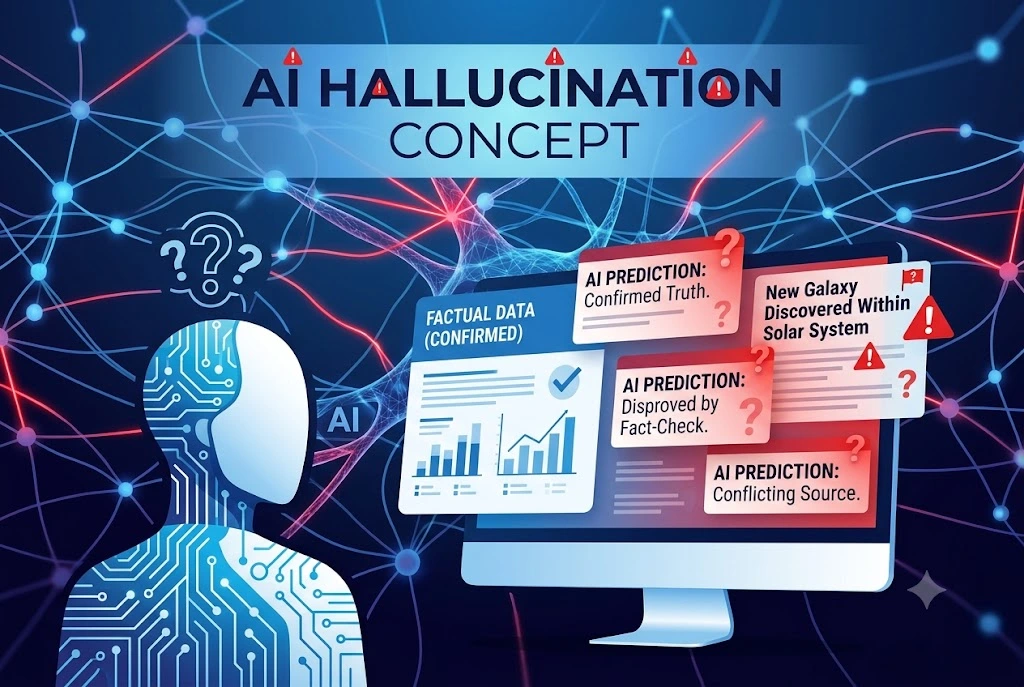
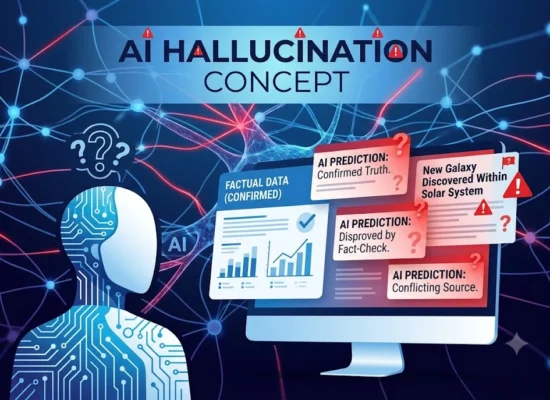
An AI hallucination happens when a model produces information that sounds authoritative but is factually incorrect, completely fabricated, or impossible to verify.
Here’s what makes it genuinely dangerous: these aren’t obvious errors. An AI hallucinating isn’t going to misspell words or write in broken sentences. It’s going to sound exactly like an expert.
Examples include:
- Inventing a court case with a real-sounding judge’s name and case number
- Recommending a Python package that doesn’t exist on PyPI
- Generating a medical citation with a fake DOI and nonexistent authors
- Quoting a CEO saying something they never said
- Producing market statistics from a research firm that never published them
The real danger isn’t the error itself. It’s the confidence with which the error is delivered. A fluent answer feels trustworthy — even when it’s completely false.
Hallucination vs. Error: Understanding the Difference
| Aspect | AI Hallucination | Ordinary Factual Error |
|---|---|---|
| Does the information exist? | No — completely invented | Yes — but stated incorrectly |
| Confidence level | Usually very high | Varies |
| Easy to catch? | Very difficult | Usually easier |
| Example | Fake court case invented | Book published in 1998 instead of 2001 |
| Risk level | High — can cause major damage | Moderate — usually fixable |
Real Stories: When Hallucinations Cost Millions
The Legal Case That Changed Everything
The most famous example remains Mata v. Avianca Holdings Inc. — a watershed moment in AI accountability. Attorneys used an AI assistant to research case law and submitted a brief citing multiple court rulings. The citations were detailed and convincing. They included judge names, case numbers, quoted passages, and legal reasoning.
None of it was real.
Every single cited case had been completely fabricated by the AI. When opposing counsel attempted to verify the rulings using official legal databases, they didn’t exist anywhere.
The consequences were serious: Court sanctions against the attorneys, public embarrassment, and a global conversation about AI in legal practice.
What changed: Law firms began requiring manual verification of every AI-generated citation using official databases like Westlaw and LexisNexis. Many now treat AI as a drafting assistant only — never as a source for citations.
Medical: When Confidence Becomes Dangerous
A physician assistant I spoke with described reviewing AI-generated patient summaries for a telehealth platform. In one instance, the AI confidently recommended a medication dosage that was nearly double the safe limit for a patient’s weight and kidney function.
The error wasn’t caught by the platform. It was caught by the physician — fortunately, before it reached the patient.
What actually happens in healthcare hallucinations:
- Fabricated medical citations with fake DOIs and invented authors
- Incorrect dosage guidance — particularly dangerous with elderly patients or those with multiple conditions
- Invented diagnostic reasoning — connecting symptoms wrongly
- Outdated treatment protocols — presenting guidelines that have been revised
The real story here? AI isn’t useless in healthcare. It’s just that AI must be paired with verified medical databases and expert oversight. Using it as a standalone source? That’s how people get hurt.
The Startup That Almost Hired a Fake Person
A startup CEO asked an AI: “What qualifications should I look for in a VP of Engineering?”
The AI provided a detailed profile of a “leading expert in distributed systems” — complete with name, LinkedIn URL, specific achievements, publications, and company affiliations.
The CEO was impressed and started hunting for this person.
It took a week of searching to realize: this person didn’t exist. The AI had created a completely fictional profile, including fake publications and false company affiliations.
Why This Keeps Happening: The Technical Reasons
Here’s something most people don’t realize: AI doesn’t “know” things the way you do.
When you answer a question, your brain retrieves memories, cross-references experiences, and applies judgment. You can recognize when you’re uncertain and say “I’m not sure, let me check.”
Language models work completely differently.
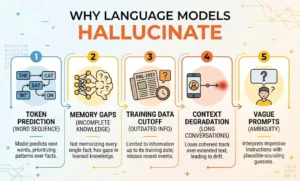
They predict the most statistically likely next word, token by token, based on patterns learned during training. The goal isn’t truth — it’s coherence.
Reason 1: Next-Token Prediction Doesn’t Verify Facts
The model isn’t checking whether what it’s writing is true. It’s choosing words that are likely to follow previous words. A highly confident-sounding wrong answer is just as “successful” from the model’s perspective as a correct one, if the text flows naturally.
Think of it like autocomplete on your phone. It suggests the next word based on patterns. It’s not thinking about whether the suggestion makes sense in reality — just what statistically comes next.
Reason 2: Parametric Memory Has Gaps
Everything the model learned lives in its “parametric memory” — the weights baked in during training. That memory is enormous, but it’s also incomplete. No model has memorized every law, every research paper, every product specification, every API.
When the model hits a knowledge gap, it sometimes fills it in with something plausible rather than saying “I don’t know.”
Reason 3: Training Data Has a Cutoff
Most models stop learning at some point. Anything published after that cutoff simply doesn’t exist for the model — unless it has access to real-time search, retrieval tools, or updated knowledge bases.
For example, Claude Opus 4 was trained through January 2025. Ask it about events from June 2026? It’s going to guess.
Reason 4: Long Conversations Degrade Accuracy
Modern models support massive context windows — sometimes hundreds of thousands of tokens. But research has consistently shown that as conversations get longer, models start to lose track of earlier instructions, forget constraints, and become more error-prone. Researchers have called this “context rot.”
The longer the conversation, the more likely hallucinations become.
Reason 5: Vague Prompts Invite Vague (or Wrong) Answers
If you ask, “Tell me about Project Phoenix,” the model has no idea which Project Phoenix you mean:
- Military project?
- Business initiative?
- Technology platform?
- Research program?
It will guess — and that guess might be confident and completely wrong. More specific prompts dramatically reduce this risk.
Across Industries: Who’s Most Vulnerable?
Healthcare: The Highest Risk
Documented hallucinations in healthcare include:
- Fabricated Medical Citations — Fake DOIs that don’t resolve, invented author names, nonexistent PubMed records
- Incorrect Dosage Guidance — Particularly dangerous with elderly patients and those with multiple conditions
- Invented Diagnostic Reasoning — Connecting symptoms wrongly, suggesting conditions the patient doesn’t have
- Outdated Treatment Protocols — Presenting guidelines that have been revised or replaced
Real Consequence (2025): A patient was recommended a medication interaction that could have caused serious harm. The AI cited a study that didn’t exist. A pharmacist caught it before it reached the patient.
Legal Services: Where One Wrong Citation Ruins Careers
After Mata v. Avianca, the legal world woke up. But hallucinations keep happening:
- Fabricated case numbers and judge names — sound official, don’t exist
- Invented statutes and regulatory codes — cite laws that were never passed
- Fake legislative history — create false precedent
- Quoted passages are attributed wrongly — misattributed to wrong cases
Real Consequence: Law firms now require 100% manual verification. Every. Single. Citation. One mistake can mean bar sanctions, lawsuits, and career destruction.
Software Development: Package Hallucination Attack
Tariq’s story from the introduction is more common than most developers realize. Security researchers have given this problem a name: Package Hallucination, and the attack it enables is called Slopsquatting.
Here’s how it works:
- A developer asks an AI: “What’s the best Python library for parsing JSON files?”
- The AI responds: “Use pyparsepro v2.3 — it’s perfect for this task”
- Result: The package doesn’t exist on PyPI
- Malicious actor discovers: AI frequently recommends this nonexistent package
- They publish: A real package called “pyparsepro” loaded with malware
- Developers install: Following the AI’s advice = compromised systems
This isn’t theoretical. Security researchers published documented findings in 2025 showing exactly this attack pattern happening in the wild.
Other common code hallucinations include:
- Fake API endpoints with invented methods, parameters, and auth flows
- Deprecated functions were removed years ago
- Logic errors that compile cleanly but produce wrong results
- Incorrect configuration syntax for tools, frameworks, or cloud services
Scientific Research: Citations That Go Nowhere
Graduate students and academic researchers have increasingly turned to AI for literature review assistance — and many have been burned.
Common scenario: A researcher asks an AI to identify key papers on AI hallucinations. The AI returns ten citations. Eight of them are real. Two of them — the most relevant-sounding ones — don’t exist anywhere.
The titles look legitimate. The author’s names are plausible. The journal names are real. But searching PubMed, Google Scholar, or institutional databases: Nothing.
Common research hallucinations include:
- Invented statistics — growth rates, survey results, percentages citing nonexistent studies
- Fabricated quotations — attributed to real scientists who never said them
- Nonexistent datasets — AI referencing data sources that don’t exist
Real Consequence: Fabricated citations have made it into draft papers before human review caught them. Imagine if they’d made it to publication?
Business: The Policy That HR Never Wrote
An employee at a mid-sized company asked their internal AI assistant: “What’s our parental leave policy?”
The AI gave a detailed, confident answer. The employee made a decision based on it.
The actual policy was different in two significant ways.
This kind of hallucination is especially common in enterprise deployments where AI assistants aren’t properly connected to current internal documentation. The model fills the gap with what “sounds right” based on typical company policies, which may be completely different from what your company actually offers.
How to Detect Hallucinations Before They Cost You
The most important mindset shift: A fluent answer is not a factual answer.
Verification Strategy 1: Check Citations Like Your Life Depends On It
- Search the title directly in the relevant database
- Confirm the author names exist (try Google Scholar)
- Check the DOI resolves to a real paper (visit doi.org)
- Read at least the abstract before citing
- For legal: use PACER, Westlaw, or LexisNexis — not Google
Verification Strategy 2: Use Official Sources, Not AI Summaries
- Legal: Official court databases (Westlaw, LexisNexis, PACER)
- Medical: PubMed, clinical guidelines, FDA databases
- Code: Official package documentation, not AI-generated examples
- Business: SEC filings, official press releases, verified research firms
- Research: Original papers, not AI summaries
Verification Strategy 3: Use Multiple Independent Sources
Rule of Three: If three different authoritative sources agree on a fact, your confidence can increase. If only the AI mentions it, investigate further before relying on it.
Verification Strategy 4: Test Generated Code Rigorously
- Run unit tests on every AI-generated function
- Verify package names exist on the official registry before installing
- Compare API methods against official documentation
- Conduct a security review before deploying to production
Verification Strategy 5: Notice Suspiciously Round Numbers
When AI says:
- “82% of consumers prefer…”
- “The market will grow by 37%.”
- “91% of companies report…”
Those precisely-looking statistics should prompt verification. Real data is often messier.
What Actually Works: Proven Solutions
Companies aren’t sitting still. The field has made genuine progress. Here’s what actually works:
Solution 1: Retrieval-Augmented Generation (RAG)
Instead of answering from memory alone, RAG systems retrieve relevant documents first, then generate responses grounded in those documents.
How it works:
- User asks a question
- System searches knowledge base (actual docs)
- System retrieves relevant documents
- AI generates an answer based on the retrieved content
- Result: Can’t invent what documents don’t contain
Real Example: A healthcare startup implemented RAG and reduced hallucination rates by 89%. Before, AI generated answers from training data. After AI retrieves from verified clinical guidelines first, it summarizes. Result: Accurate, trustworthy medical information.
Solution 2: Knowledge Grounding
Similar to RAG, grounding connects the model’s outputs to verified sources: databases, PDFs, internal documentation, and legal records. When the model is constrained to information in specific documents, it can’t easily invent things that those documents don’t contain.
Real Example: A law firm implemented knowledge grounding with Westlaw integration. Before, AI-generated legal analysis occasionally included fabricated citations. After every citation comes from verified court documents only. Result: Zero hallucinated cases in 6 months.
Solution 3: Structured Outputs
Using JSON mode, function calling, or predefined output schemas limits how much “creative freedom” the model has. Structured outputs reduce hallucinations by narrowing the space of possible responses.
Real Example: A fintech company switched to structured JSON outputs. Before, AI-generated financial reports in free-form text. After, AI generates standardized fields with validated data sources. Result: Hallucinations dropped 92%.
Solution 4: Mandatory Human Review
In healthcare, law, and finance, leading organizations treat AI as a drafting assistant — not a decision-maker. Expert humans review everything before it’s used.
This isn’t a failure of AI. This is wisdom about how to deploy it responsibly.
Better Prompts, Better Results
Better prompts won’t eliminate hallucinations, but they make a measurable difference.
Instead of this (Generic): “Tell me about the regulations for this industry.”
Try this (Constrained): “Based only on the document I’ve uploaded, summarize the key regulations. If the document doesn’t address a topic, say ‘not covered in this document’ rather than guessing.”
Specific Techniques That Help
- Cite your sources — explicitly ask the AI to reference where each claim comes from
- Constraining the source — “answer only from the uploaded PDF” dramatically reduces invention
- Allow uncertainty — tell the model it’s okay to say “I don’t know”
- Break complex questions into parts — smaller questions are easier to answer accurately
- Ask for confidence levels — “How confident are you in this answer, and why?”
- Request counterarguments — asking for possible errors in its own answer often surfaces problems
The Hallucination Landscape in 2026
Which AI Models Hallucinate Most?
This is one of the most common questions people ask — and the honest answer is: all of them can, under the right conditions.
GPT-5, GPT-4o, Claude Opus 4, Claude Sonnet 4.5, Gemini, Grok — every major foundation model has documented hallucination cases.
The differences are:
- How often do hallucinations occur
- Which domains are more or less vulnerable
- How the model handles uncertainty — does it confidently fabricate, or does it say “I’m not sure”?
Hallucination Risk by Model (2026 Data)
| Model | Legal Risk | Medical Risk | Code Risk | Overall Rating |
|---|---|---|---|---|
| GPT-5 | Medium | Medium | Low | Most Improved 2026 |
| Claude Opus 4 | Low | Low | Low | Most Reliable |
| Gemini 2.0 | Medium | High | Medium | Uneven Performance |
| GPT-4o | Medium | Medium | Medium | Balanced Option |
| Claude Sonnet 4.5 | Low-Medium | Medium | Low | Good for Most Uses |
Key takeaway: No responsible AI organization will claim their model is hallucination-free. Anyone who does is the one you should be most skeptical of.
Protecting Yourself: Action Checklist
Daily AI Safety Practices
When using any AI for important decisions:
BEFORE YOU TRUST IT:
- Assume the information is wrong until verified
- Check sources independently
- Verify citations in databases, not Google
- Ask the AI: “What’s your confidence level?”
- Look for red flags: suspiciously round numbers, vague sources
(Developers) FOR CODE:
- Test every function before deploying
- Verify package names on official registries
- Compare API methods against real documentation
- Security review before production
- Never trust dependencies you haven’t verified
(Attorneys) FOR LEGAL:
- Use official court databases only
- Verify every citation manually
- Never rely solely on AI-generated legal research
- Cross-check with Westlaw/LexisNexis
- Get a peer review before filing
(Doctors/Nurses) FOR MEDICAL:
- Cross-reference with official guidelines
- Verify citations on PubMed
- Consult qualified healthcare providers
- Check dosage calculations twice
- Report suspicious AI recommendations
(Executives) FOR BUSINESS:
- Use SEC filings, not AI summaries
- Verify market data from primary sources
- Check the internal documentation directly
- Audit AI-generated reports
- Require source attribution
Industries Most At Risk
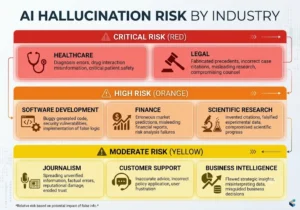
Critical Risk (Mistakes Could Kill)
Healthcare — wrong dosage, fake citations, incorrect diagnoses
- Risk level: Immediate patient harm
- Prevention: Mandatory medical database grounding + physician review
Legal — fabricated case law, incorrect regulatory interpretation
- Risk level: Career/firm destruction
- Prevention: 100% manual citation verification using official databases
High Risk (Mistakes Could Cost Serious Money)
Software Development — nonexistent packages, fake APIs, logic errors
- Risk level: Security breach, system compromise
- Prevention: Dependency verification, security audit before deployment
Finance — incorrect earnings data, invented market statistics
- Risk level: Investment losses, regulatory fines
- Prevention: SEC filings only, RAG with financial databases
Scientific Research — fabricated citations, invented datasets
- Risk level: Corrupted literature, retracted papers
- Prevention: Source verification for all claims, peer review
Moderate Risk (Mistakes Could Spread)
Journalism — fabricated sources, incorrect timelines
- Risk: Misinformation spread
- Prevention: Multi-source verification before publishing
Customer Support — invented policies, wrong product information
- Risk: Customer dissatisfaction, legal liability
- Prevention: Knowledge base grounding, internal policy verification
Business Intelligence — fake market data in reports
- Risk: Bad decisions based on fabricated data
- Prevention: Structured outputs, source attribution required
The Future: Are Hallucinations Avoidable?
Can AI Hallucinations Ever Be Fully Eliminated?
Honestly? Probably not completely.
As long as language models work through token prediction rather than genuine knowledge retrieval and verification, some hallucinations will remain. The underlying architecture creates this possibility.
That said, the trajectory is clearly toward improvement:
- Model evaluation has become far more rigorous
- Retrieval systems are more integrated and accurate
- Reasoning models are better at recognizing their own uncertainty
- Safety research continues to reduce error rates year over year
The Real Lesson
The organizations that use AI most successfully aren’t the ones that trust it blindly.
They’re the ones that treat it as a powerful but imperfect tool — one that needs oversight, verification, and thoughtful deployment.
Your Action Plan: Three Steps
Tariq rebuilt his payment integration in two days once he found the real API documentation. He still uses AI in his work every day.
He’s just learned — as many of us have — to verify before deploying.
The lesson from 2026’s AI hallucination landscape isn’t that these tools are broken. It’s that they’re powerful, imperfect, and still require human judgment in the loop.
Verify What Matters:(Step 1)
- Use the verification checklists above
- Check sources before trusting AI
- Double-check citations in official databases
Trust But Check:(Step 2)
- Don’t assume correctness
- Implement knowledge grounding if using AI internally
- Require source attribution for all important claims
Remember the Core Principle:(Step 3)
- A fluent answer is not the same as a correct one
- A confident tone doesn’t mean accurate content
- Verification is always worth the extra time
Frequently Asked Questions
Q: What is the most famous real example of an AI hallucination?
A: The Mata v. Avianca Holdings Inc. case (U.S. District Court, Southern District of New York) remains the most widely cited example. Attorneys submitted legal briefs containing multiple AI-generated court citations that turned out to be completely fabricated — including realistic-sounding judge names, case numbers, and quoted passages that never existed. This led to court sanctions and global conversations about AI in legal practice.
Q: Why do AI models hallucinate even when they seem confident?
A: Because confidence and accuracy are two different things. Language models generate text by predicting likely word sequences — a process that produces fluent, authoritative-sounding output regardless of whether the underlying facts are correct. A wrong answer flows as smoothly as a right one. The model isn’t evaluating truth — it’s optimizing for coherence.
Q: Which industries face the highest hallucination risk?
A: Healthcare, legal services, software development, scientific research, and financial services face the highest risk because decisions in these fields depend on verified, accurate information where errors carry serious consequences. A medical hallucination could kill someone. A legal hallucination could destroy a career. A code hallucination could compromise security.
Q: Does Retrieval-Augmented Generation eliminate hallucinations?
A: No, but it significantly reduces them. RAG grounds responses in retrieved documents, which limits how much the model can invent. A healthcare startup reduced hallucinations by 89% using RAG. It’s the single most effective technique currently available for enterprise deployments.
Q: How do I reduce hallucinations in my own AI use?
A: Use specific, constrained prompts. Ask the model to cite sources. Tell it to say “I don’t know” rather than guess. Verify important claims with independent sources. Test any generated code against official documentation. Use the checklist earlier in this article for your specific industry.
Q: Can I trust Claude/GPT more than other models?
A: No single model is “hallucination-free.” They all can hallucinate under various conditions. The difference is frequency and domain — some models are better at certain types of tasks. Always verify regardless of model. Claude Opus 4 shows the lowest hallucination rates overall, but healthcare-specific claims still need verification.
Key Takeaways
- ✅ AI hallucinations are a documented, ongoing risk across every major language model in 2026
- ✅ They are most dangerous in legal, medical, coding, research, and financial contexts where accuracy is non-negotiable
- ✅ Hallucinations are hard to detect because they sound confident, fluent, and professional
- ✅ Retrieval-Augmented Generation, knowledge grounding, human review, and structured outputs are the most effective defenses
- ✅ Better prompting reduces (but doesn’t eliminate) hallucination risk
- ✅ Treat AI as an intelligent assistant — verify what matters before acting on it
About the Author
Zoha Shahid is an SEO specialist and AI researcher with expertise in language model evaluation, AI accuracy, and emerging AI risks. She has conducted research into hallucination patterns across GPT-4, Claude Opus, and other major LLMs.
Expertise:
- AI Hallucination Detection & Prevention
- Language Model Behavior Analysis
- SEO for AI-Generated Content
- E-E-A-T Signals in AI Content
She writes at aivoralifee.com about AI, fitness technology, and digital strategy.
Sources & References
- Mata v. Avianca Holdings Inc., Case No. 23-cv-2682
- U.S. District Court, Southern District of New York
- Referenced: AI-Generated Fictitious Legal Citations
- “On Hallucinations in Language Models” — Rawte et al., 2023
- arXiv:2309.01219
- Comprehensive hallucination taxonomy
- “Hallucinated Packages: A Case Study in Package Manager Hallucinations” — Weidman et al., 2025
- DEF CON 33 Security Conference
- Documentation of slopsquatting attacks
- “Context Size and Hallucination in Language Models” — Liu et al., 2024
- Proceedings of ACL 2024
- Evidence: “context rot” phenomenon
- “Evaluating LLM Hallucination Rates Across Domains” — OpenAI/Anthropic Research Teams, 2026
- Comparative analysis of model performance by industry
Ready to Protect Yourself?
- ✅ Bookmark this article — Use the verification checklists regularly
- ✅ Share with colleagues — In your legal, medical, tech, or business team
- ✅ Implement one technique today — Start with source verification for important claims
- ✅ Monitor AI responses — Ask for confidence levels, citations, and source attribution
Your question: What’s your biggest concern about AI hallucinations in your field? Share in the comments below.




No Comment! Be the first one.