



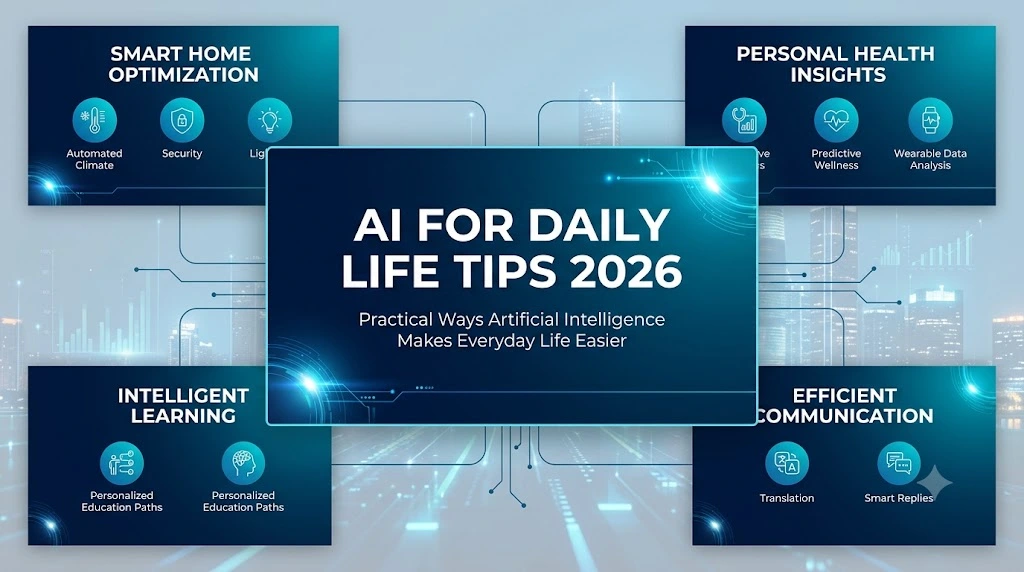
AI for Daily Life Tips 2026: Artificial intelligence is no longer a concept confined to science fiction or Silicon Valley labs. In 2026, it is embedded in the fabric of everyday life — from the moment your alarm goes off with a weather-adjusted wake time, to the AI-curated playlist you stream on your commute, to the fraud detection system quietly protecting your bank account while you sleep. The shift has been so gradual that most people have not noticed how dependent their daily routines have become on machine intelligence.
Table Of Content
- AI in Your Smartphone: The Device That Thinks With You
- On-Device AI Processing
- Predictive Text and Smart Replies
- Computational Photography
- AI for Productivity: Getting More Done Without Working Harder
- AI Writing Assistants
- Meeting Intelligence
- Calendar and Task Management
- AI in Education: Personalized Learning at Scale
- Adaptive Learning Platforms
- AI as a Study Partner
- Language Learning Transformation
- AI in Healthcare: Your Health, Better Understood
- Wearable Health Monitoring
- AI-Assisted Diagnostics
- Mental Health Support
- AI in Shopping and Finance: Smarter Decisions With Less Effort
- Recommendation Systems
- AI-Powered Personal Finance
- Fraud Detection
- AI in the Home: Environments That Adapt to You
- Energy Management
- AI Security Systems
- Challenges and Honest Limitations
- Conclusion: AI Is a Tool, Not a Destination
This guide is not about hype or distant promises. It is a grounded, practical look at where AI is already making a measurable difference in how ordinary people navigate their days — and how you can take better advantage of it.
AI in Your Smartphone: The Device That Thinks With You
Your smartphone is the most powerful AI device most people will ever own, yet the majority of users use less than 30% of its intelligent capabilities. Here is what is actually happening inside that glass rectangle:
On-Device AI Processing
Modern smartphones — whether Apple, Samsung, or Google Pixel — now contain dedicated neural processing units (NPUs). These chips handle AI tasks locally, without sending your data to the cloud. This means faster responses, better privacy, and AI that works even without internet. Apple’s Neural Engine, for example, processes over 38 trillion operations per second on newer iPhones, enabling real-time translation, live photo enhancement, and on-device speech recognition.
Predictive Text and Smart Replies
Your keyboard learns your writing patterns over time. The AI behind it does not just predict the next word — it understands your tone, adapts to context (professional email versus casual chat), and even suggests entire responses. In Gmail and Messages, smart reply suggestions now analyze not just your writing style but the emotional tone of incoming messages to propose contextually appropriate responses.
Computational Photography
AI processes every photo you take on a modern smartphone before it reaches your camera roll. Night Sight on Pixel phones uses machine learning to capture up to 15 frames at different exposures and merge them into a single sharp, well-lit image. Portrait mode estimates depth using AI, not just hardware sensors. Object recognition identifies what you are photographing and adjusts color temperature, contrast, and sharpness accordingly. The camera you are using today would have been considered professional-grade equipment five years ago — AI is the reason why.
AI for Productivity: Getting More Done Without Working Harder
The productivity revolution powered by AI is not about replacing human effort — it is about eliminating the low-value tasks that consume time without producing results. Here are the areas where AI has made the most significant impact:
AI Writing Assistants
Tools like Claude, ChatGPT, and Gemini have matured considerably. In 2026, the most practical use cases are not dramatic — they are mundane in the best possible way. Professionals use AI to draft first versions of reports, summarize lengthy documents, rewrite unclear paragraphs, and prepare talking points for meetings. Studies from Stanford and MIT suggest that knowledge workers using AI writing assistance complete drafting tasks 40-55% faster, with equivalent or better quality outcomes.
Meeting Intelligence
AI meeting tools like Otter.ai, Fireflies, and Microsoft Copilot in Teams do not just transcribe — they identify action items, summarize decisions, highlight disagreements, and even flag when important topics were discussed but not resolved. Some teams have entirely eliminated manual meeting notes. The AI produces a structured summary within seconds of the call ending.
Calendar and Task Management
AI-powered calendar tools like Reclaim.ai and Motion analyze your task list, meeting load, deadlines, and energy patterns to automatically schedule focused work blocks. They protect time for deep work, reschedule lower-priority tasks when urgent items arise, and even learn that you do better creative work in the mornings and analytical tasks in the afternoons. This kind of intelligent time management was only accessible to executives with personal assistants a decade ago.
AI in Education: Personalized Learning at Scale
Education is experiencing a fundamental shift. For the first time in history, it is technically possible for every student to have access to a patient, knowledgeable tutor available 24 hours a day. AI is making that possible, though the reality is more nuanced than the headlines suggest.
Adaptive Learning Platforms
Platforms like Khan Academy’s Khanmigo, Duolingo, and Coursera now use AI to track not just whether a student answered correctly, but how long they hesitated, which options they considered, and which concepts consistently cause confusion. The system adjusts difficulty in real time, revisits weak areas, and presents material in formats that match the learner’s demonstrated preferences — visual, auditory, or problem-based.
AI as a Study Partner
Students are increasingly using conversational AI as a study partner rather than a shortcut. The most effective use is Socratic — asking AI to quiz you, to explain concepts from different angles, to generate practice problems at increasing difficulty, and to identify gaps in understanding. Research from Carnegie Mellon shows that students who use AI for active retrieval practice (rather than passive reading) retain information significantly better.
Language Learning Transformation
Duolingo’s AI now provides real-time spoken conversation practice with natural feedback on pronunciation, grammar, and vocabulary. Unlike traditional language apps, the AI adapts to your proficiency mid-conversation, introducing new vocabulary organically and correcting errors in context. Users are reaching conversational fluency in 12-18 months — a timeline that previously required expensive immersion programs or years of traditional study.
AI in Healthcare: Your Health, Better Understood
Healthcare is arguably the domain where AI carries the highest stakes — and where it is already producing some of its most remarkable results. The shift is happening across three levels: consumer wearables, clinical diagnostics, and drug discovery.
Wearable Health Monitoring
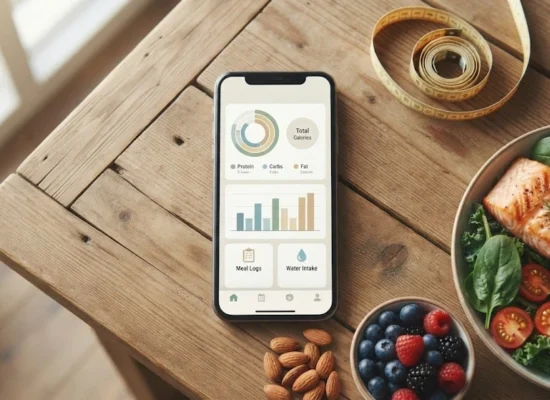
The Apple Watch, Samsung Galaxy Watch, and Fitbit now continuously monitor heart rate variability, blood oxygen saturation, skin temperature, sleep architecture, and (on newer models) blood glucose trends — all using AI to distinguish meaningful patterns from normal variation. In 2023, Apple Watch’s AFib detection algorithm alone was credited with prompting thousands of users to seek early medical evaluation who were unaware of their irregular heartbeat.
AI-Assisted Diagnostics
Google’s DeepMind has developed AI systems that detect over 50 eye diseases from retinal scans with accuracy comparable to specialist ophthalmologists. Similar systems exist for reading mammograms, detecting skin cancer from photographs, and identifying early-stage lung cancer in CT scans. These tools do not replace doctors — they help radiologists and specialists work more efficiently and catch cases that might otherwise be missed.
Mental Health Support
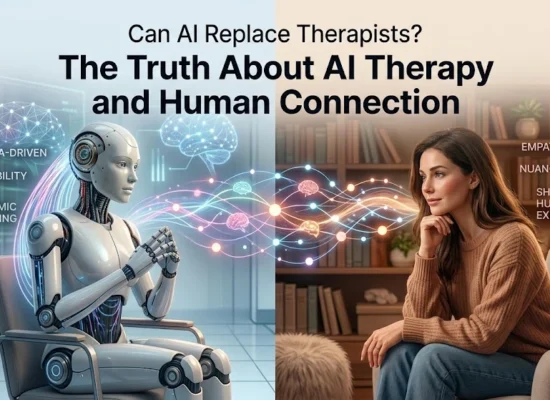
AI-powered mental health apps like Woebot and Wysa use evidence-based cognitive behavioral therapy techniques in a conversational format. They are not replacements for therapists — they serve a different function: providing immediate, low-barrier support between therapy sessions, during late-night anxiety spirals, or for people who cannot access or afford traditional mental health care. Studies show consistent improvement in depression and anxiety symptoms among regular users.

AI in Shopping and Finance: Smarter Decisions With Less Effort
Consumer AI has fundamentally changed how people discover products, make purchases, and manage money — often invisibly.
Recommendation Systems
Amazon’s recommendation engine generates approximately 35% of the company’s total revenue. Netflix’s algorithm saves an estimated one billion dollars annually in customer retention. These systems analyze not just what you have bought or watched, but how long you hovered over an item, what time of day you browse, how your preferences have evolved, and what people with similar profiles enjoyed. Modern recommendation AI goes far beyond “people who bought X also bought Y” — it builds a nuanced model of your preferences that often surfaces things you did not know you wanted.
AI-Powered Personal Finance
Apps like YNAB, Cleo, and Monarch Money use AI to categorize transactions automatically, identify spending patterns, flag unusual charges, and project your financial situation weeks or months ahead based on your history. Some banks now offer AI advisors that proactively alert you when a bill seems higher than usual, when you are approaching your budget limit, or when a better savings rate is available — without you having to ask.
Fraud Detection
Every time you swipe your credit card, an AI system analyzes hundreds of variables in milliseconds — your location, the merchant category, the transaction amount, the time of day, your typical spending patterns — and assigns a fraud probability score. Visa’s AI fraud detection system processes over 65,000 transactions per second. The reason you rarely experience credit card fraud despite billions of transactions occurring daily is largely that AI has made fraud extraordinarily difficult to execute at scale.
AI in the Home: Environments That Adapt to You
Smart home technology has evolved from simple voice commands to genuinely intelligent environments that learn your routines and anticipate your needs.
Energy Management
Google Nest thermostats learn your schedule and temperature preferences within a week of installation. More importantly, they access local weather forecasts, electricity pricing data, and even your home’s thermal properties to optimize heating and cooling in ways that reduce energy costs by an average of 10-15% annually without any manual input from the homeowner. Some models now integrate with electric vehicle charging schedules and solar panel output to optimize whole-home energy consumption.
AI Security Systems
Modern security cameras with AI can distinguish between a person, a car, an animal, and a tree branch moving in the wind — eliminating 95% of false alarms that plagued earlier motion-sensor systems. Ring and Arlo cameras now recognize familiar faces and can alert you when an unknown person approaches, while not notifying you when your dog walks past. Some systems learn the normal pattern of activity in and around your home and alert you only when something genuinely anomalous occurs.
Challenges and Honest Limitations
No honest guide to AI in daily life would be complete without addressing what AI cannot do well — and the genuine risks that come with increasing reliance on these systems.
- Privacy trade-offs: Most AI systems that learn your preferences require data collection. Understanding what data is collected, how it is stored, and who can access it remains essential. Convenience should not come at the cost of uninformed data sharing.
- AI hallucinations: Conversational AI systems, including the most advanced models, still produce confident-sounding but incorrect information. Any factual claim from an AI assistant should be verified through authoritative sources, especially in medical, legal, or financial contexts.
- Algorithmic bias: AI systems trained on historical data can perpetuate and amplify existing biases. This is particularly significant in hiring algorithms, loan approval systems, and facial recognition — areas where AI errors carry real consequences for real people.
- Skill atrophy: Over-reliance on AI for tasks like navigation, writing, and calculation can erode the underlying skills. Using AI as a tool to augment capability is healthy; using it as a complete substitute risks creating dependency that becomes a liability when the tool is unavailable.
- Security risks: AI systems themselves are targets for manipulation. Prompt injection attacks, adversarial inputs that fool image recognition systems, and deepfake-enabled fraud represent a growing threat landscape that individuals and organizations must actively prepare for.
Conclusion: AI Is a Tool, Not a Destination
The most important thing to understand about AI in 2026 is that it is not finished. The systems you use today will seem primitive compared to what exists five years from now. But the fundamental questions remain constant: What problems are you trying to solve? What do you gain and what do you give up? How do you stay in control of the tools that are designed to assist you?
AI offers genuine leverage — the ability to accomplish more with less time and effort, to access expertise that was previously out of reach, and to make better decisions with better information. The people who benefit most from AI are not the ones who hand control over to it, but those who learn to collaborate with it intelligently.
The technology is here. The question now is how wisely you choose to use it.




No Comment! Be the first one.