


How to Protect Your Parents and Kids from AI Voice Cloning Scams in 2026
The year is 2026, and the digital landscape has shifted. Technology that once seemed like science fiction is now readily accessible to everyone—including those with malicious intent. Among the most alarming developments is the rise of AI voice cloning scams. If you have ever felt a chill down your spine hearing a loved one’s voice on the phone, only to realize the context didn’t quite add up, you aren’t alone.
Table Of Content
- What is an AI Voice Cloning Scam?
- How Scammers Choose Their Targets
- The Nightmare Realized: A True Story of AI Deception
- The “Family Safe Word”: Your Secret Weapon Against AI
- What is a Family Safe Word?
- Why It Works
- How to Implement It
- Understanding the Emotional Hijacking Strategy
- Proactive Steps to Secure Your Family’s Digital Footprint
- Strategic Steps to Family Digital Safety
- 1. The “Family Code Word” Protocol
- 2. Verify Through Secondary Channels
- 3. Lockdown Your Digital Presence
- Technical Defenses and Resources
- Tools for Enhanced Awareness
- Frequently Asked Questions (FAQ)
- Conclusion: Staying Vigilant in 2026
AI-powered voice cloning, or “vishing,” is no longer a fringe threat; it is a multi-billion-dollar industry of deception. With just three seconds of audio, sophisticated AI tools can now replicate a person’s pitch, cadence, and emotional inflection with startling accuracy. Whether it is a frantic child “trapped” in an emergency or a parent asking for an urgent wire transfer, the goal is to trigger your fear and bypass your logic.
In this guide, we will break down how to protect your family from these threats using proactive strategies and a deeper understanding of how these scams operate.
What is an AI Voice Cloning Scam?
At its core, an AI voice cloning scam is a form of social engineering. Fraudsters use generative AI to synthesize a person’s voice, often harvesting audio samples from social media videos, voicemail greetings, or public interviews.
I remember sitting at dinner when my own mother called, sounding uncharacteristically frantic. She claimed she had lost her purse and needed me to send money to a “friend’s” account immediately. The panic in her voice felt so real that for a split second, I reached for my banking app. It was only when I asked a question about a private family joke that the “person” on the other end hung up. That’s the moment you realize how thin the line between reality and deception has become.
How Scammers Choose Their Targets
Scammers don’t always pick random numbers. They often research their targets, looking for:
-
Digital Footprints: Public social media profiles where you or your kids post videos of yourselves speaking.
-
Elderly Relatives: Seniors are often targeted because they may be less familiar with the nuances of modern AI and are naturally inclined to help family members in distress.
-
High-Pressure Moments: They strike when they think you are most vulnerable—late at night or during travel periods when family members might legitimately be away from home.

The Nightmare Realized: A True Story of AI Deception
We often think, “It won’t happen to me,” or “I would know if it wasn’t my child calling.” But the reality is far more chilling.
Take the case of Jennifer DeStefano, a mother from Arizona whose story sent shockwaves across the globe via CNN. In 2023, Jennifer received a phone call from an unknown number. When she answered, she heard the terrified, sobbing voice of her 15-year-old daughter, Brianna. “Mom, I messed up!” the voice screamed.
Then, a man’s voice took over, threatening to harm her daughter if Jennifer didn’t pay a $1 million ransom immediately. “It was completely her voice,” Jennifer later recounted. “The inflection, the way she cried… I never doubted for one second it was her.”
It was only after a frantic, life-shattering four minutes—where she was surrounded by other parents at a dance studio—that she managed to confirm her daughter was actually safe and skiing on a trip. It was a perfectly executed AI-generated kidnapping hoax. The terror was real; the voice was fake.
The “Family Safe Word”: Your Secret Weapon Against AI
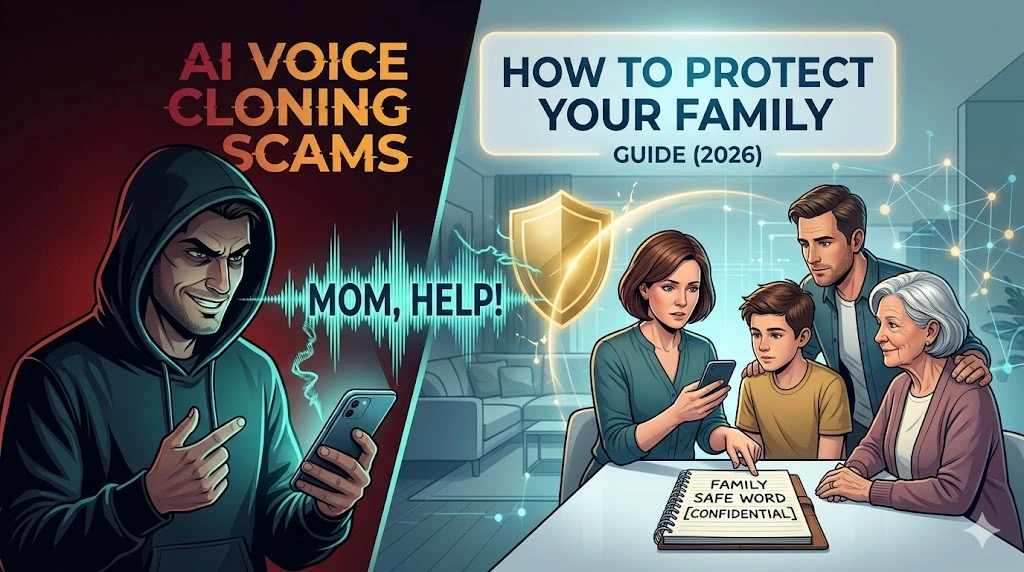
In a world where you can no longer trust your ears, you need a protocol that isn’t based on sound, but on knowledge. This is where the Family Safe Word concept comes in. It is perhaps the most overlooked, yet most effective, defense against AI voice cloning.
What is a Family Safe Word?
A “Safe Word” is a pre-agreed, secret phrase or code that only your immediate family knows. It should not be something predictable like a pet’s name, your home street, or a birth date—all of which are easily found on social media.
Why It Works
AI can clone your voice, but it cannot clone the private, shared memory of a word you agreed upon in your kitchen.
-
The Scenario: If you receive a frantic call from a “family member” asking for money or claiming to be in trouble, you simply stop and ask: “What is the family safe word?”
-
The Result: A scammer, no matter how advanced their AI, will freeze. They don’t have access to your private, offline conversations. If they can’t answer, you hang up immediately. No questions asked, no panic.
How to Implement It
-
Host a Family Meeting: Sit down with your parents and kids. Explain that “digital impersonators” are real.
-
Choose a Unique Code: Pick something abstract. Instead of “Fluffy” (the dog), choose a phrase like “Blue Penguin 42” or a line from a random book you both read.
-
Keep it Private: Never share this word in group chats, emails, or on social media. It should only exist in your minds.
-
Practice: Do a “drill” once a month so that the kids and elderly parents remember it even under extreme stress.
Understanding the Emotional Hijacking Strategy
Why do these scams work so well? Because they don’t target your brain; they target your biology.
When you hear a loved one crying, your amygdala—the brain’s “panic center”—takes over. It bypasses your logical reasoning, pushing you into a “fight or flight” state. Scammers use this to make you act quickly, before you have time to think, verify, or call for help.
I remember a time I thought I was losing my mind, receiving a call from a “bank official” using a voice that sounded identical to a relative I trust. My heart was pounding, my hands were shaking—that is exactly what they want. They bank on your panic. When you feel that surge of fear, treat it as a warning sign: this is an emotional bait.
Proactive Steps to Secure Your Family’s Digital Footprint
To stop them from cloning your voice, you must limit the “raw material” they use to build their models.
-
Scrub Public Audio: Review your social media. Are there videos of your kids singing, speaking, or telling stories? These are gold mines for AI developers. Set these posts to “Private” or “Friends Only.”
-
The Voicemail Fix: Change your personal voicemail greeting to a standard, text-to-speech, or generic recording. Avoid recording your own voice, which can be harvested by automated scrapers.
-
Educate the Vulnerable: Elderly parents are prime targets. Explain to them that no government agency or bank will ever demand payment via a phone call. If they get a call that makes them nervous, they must have a “Call Back Rule”—hang up and call their child on their known personal number.
Strategic Steps to Family Digital Safety
Protecting your household requires a multi-layered approach. It is not just about installing software; it is about changing how your family communicates.
1. The “Family Code Word” Protocol
This is your first and most effective line of defense. Sit down with your children and parents this weekend and establish a secret family phrase or code word.
-
Make it unique: It shouldn’t be a pet’s name or a street name (things easily found on Facebook).
-
The Rule: If a “loved one” calls in an emergency, they must provide the code word before any financial or sensitive action is taken. If they can’t, the call is an immediate red flag.
2. Verify Through Secondary Channels
If you receive a suspicious call, never act in urgency. Scammers count on your panic to force a quick decision.
-
Hang up: Even if the caller claims the phone line will be disconnected or that it is a “life-or-death” situation.
-
Call back: Use a saved, verified contact number to reach your family member directly. If they are truly in trouble, they will answer, or someone nearby will confirm their status.
3. Lockdown Your Digital Presence
The less “raw material” a scammer has of your voice, the harder it is for them to clone you.
-
Social Media Privacy: Set your accounts to private. Be mindful when posting videos where you or your children speak clearly and for extended periods.
-
Generic Voicemails: Avoid using your name or voice in your voicemail greeting. Use a generic text-to-speech greeting or a pre-recorded message that doesn’t reveal your unique vocal signature.

It is important to acknowledge the psychological weight of these scams. When a scammer uses your child’s voice to ask for help, your brain’s fight-or-flight response is triggered. This isn’t a failure of intelligence; it is a biological reaction to a manufactured threat.
Why we fall for it:
-
Emotional Hijacking: The scammer knows exactly which strings to pull—love, fear, and the parental instinct to protect.
-
The “Expert” Trap: Sometimes, scammers use AI to impersonate bank officials or government agents. They sound professional, calm, and authoritative, which mimics the traits we are taught to trust.
I once spoke with a victim who lost thousands of dollars because they believed they were talking to their son who had been arrested. They weren’t “gullible”—they were just parents who loved their child. The technology is designed specifically to exploit that beautiful, human instinct.
Technical Defenses and Resources
While personal habits are your best defense, leveraging technology can add an extra layer of security.
Tools for Enhanced Awareness
-
Call Filtering Services: Use apps that filter out known scam numbers and “spoofed” caller IDs.
-
Biometric Caution: Be wary of any “voice verification” prompts for accounts that you didn’t initiate.
-
Report Everything: If you are targeted, report the attempt to your local cybercrime division or the Internet Crime Complaint Center (IC3). Reporting helps authorities track the patterns and technology being used by these criminal rings.
Frequently Asked Questions (FAQ)
Q: Can I really tell the difference between a real voice and an AI clone?
A: Increasingly, no. While some clones have “robotic” pauses or strange intonations, the latest 2026 models can mimic breathing, laughter, and background noise perfectly. Do not rely on your ears; rely on the Verification Protocol.
Q: Should I tell my kids about these scams?
A: Absolutely. Use age-appropriate language to explain that “the internet can copy voices” and that they should never share their location or personal financial information with anyone—even if they think it is a friend or family member—without asking you first.
Q: What if I have already sent money?
A: Contact your bank immediately. Many financial institutions have fraud recovery departments that can halt wire transfers if alerted within the first few hours. Document the call, the number it came from, and the time, then file a report with the police.
Conclusion: Staying Vigilant in 2026
The rise of AI voice cloning in 2026 does not mean we should live in fear. It simply means we must update our “street smarts” for the digital age. By establishing family protocols, limiting what we share publicly, and training our brains to pause when an “emergency” pops up, we can effectively neutralize these threats.
Technology is moving fast, but our connection to our family is stronger. Stay skeptical, stay protected, and remember: verify, then act.
For more tips on staying safe in the age of AI, check out our full guide on Digital Wellness for Families and stay tuned for daily updates on AI safety.






No Comment! Be the first one.