


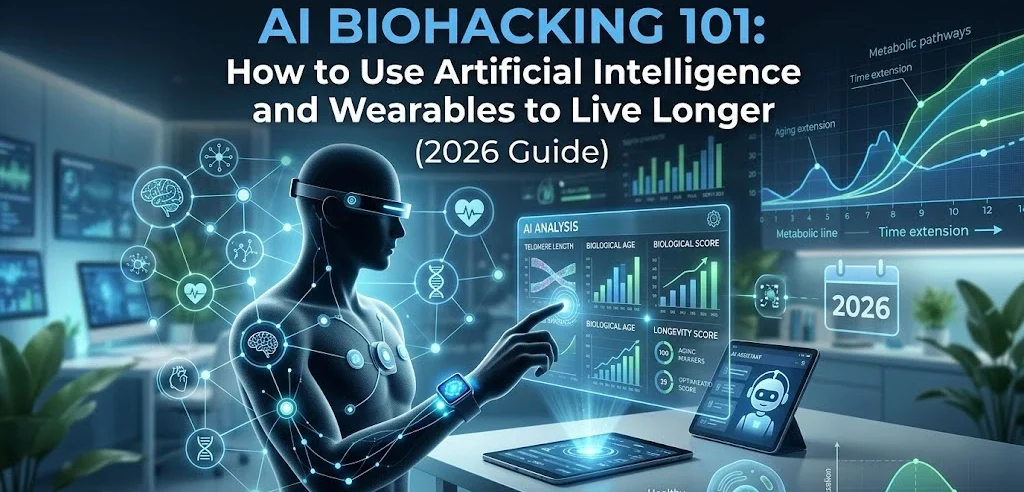
AI Biohacking 101: How to Use Artificial Intelligence and Wearables to Live Longer (2026 Guide)
Have you ever wondered how some tech entrepreneurs and health enthusiasts look and feel like they are 25 when they are actually 50? They aren’t using magic; they are using a combination of biohacking and artificial intelligence.
Table Of Content
- What is Biohacking and Why is AI Changing It?
- The Benefits of AI Biohacking for Beginners
- Key Metrics You Need to Track (And What They Mean)
- 1. Heart Rate Variability (HRV)
- 2. Blood Glucose Volatility
- 3. Sleep Architecture
- Top AI Wearables and Tools for Longevity in 2026
- How to Build Your First AI Biohacking Routine: A Step-by-Step Guide
- Step 1: Maximize Your Current Wearable
- Step 2: Let AI Optimize Your Sleep (The Foundation of Longevity)
- Step 3: Hack Your Nutrition with AI Meal Tracking
- Step 4: Follow an AI-Driven Workout Plan
- Advanced Biohacking: The Future of Lifespan Extension
- Continuous Glucose Monitors (CGMs) for Non-Diabetics
- Epigenetic Testing & AI DNA Analysis
- Common Misconceptions About AI Biohacking
- Summary: Your 3-Point Action Plan for Tomorrow
- FAQs
- Q1: Is AI biohacking safe for everyone?
- Q2: What is the cheapest way to start AI biohacking?
- Q3: How does AI calculate my “Biological Age”?
- Q4: Can smart rings really detect if I am getting sick?
- Q5: Will AI biohacking help me lose weight?
In 2026, staying healthy is no longer just about doing 30 minutes of cardio and avoiding fast food. It is about tracking your body’s data in real-time and letting AI analyze it to optimize your sleep, diet, energy levels, and overall lifespan.
If you own a smartwatch or a fitness tracker, you already have a powerful health lab on your wrist. This ultimate guide will show you exactly how to use AI biohacking for beginners to optimize your health and live a longer, disease-free life.
What is Biohacking and Why is AI Changing It?
To understand AI biohacking, we first need to break down the two terms:
-
Biohacking: The practice of making small, incremental changes to your diet, lifestyle, and environment to “hack” your body’s biology and improve your health, energy, and focus.
-
Artificial Intelligence (AI): Technology that can process massive amounts of biological data, find hidden patterns, and give you hyper-personalized recommendations.
Before AI, biohacking was guesswork. People would try a new supplement, track how they felt in a notebook, and guess if it worked. Today, AI eliminates the guesswork.
Your smart wearables collect millions of data points every second—including heart rate variability, oxygen levels, blood glucose, and sleep cycles. AI models take this data, compare it with billions of medical data points, and tell you exactly what your body needs at this very second.
The Benefits of AI Biohacking for Beginners
Why should you care about tracking your health data with AI? Here are the proven benefits of adopting this lifestyle:
-
Hyper-Personalization: Generic diet plans do not work because every human body is unique. AI looks at your specific DNA, gut microbiome, and daily activity to tell you what to eat.
-
Early Disease Prevention: Instead of going to the doctor after you get sick, AI tracks microscopic changes in your heart rate and sleep to warn you about potential illnesses days before symptoms appear.
-
Optimized Energy Levels: By understanding your circadian rhythm through AI analysis, you will know exactly when to work, when to work out, and when to rest for maximum brainpower.
-
Slowing Down Biological Age: AI helps you monitor your biological age (how old your cells are) versus your chronological age (the date on your birth certificate).
Key Metrics You Need to Track (And What They Mean)
If you want to start your longevity journey, you must focus on the core biological metrics that AI algorithms analyze. Here is a simple breakdown of the most critical health markers:
1. Heart Rate Variability (HRV)
HRV is the variation in time between each heartbeat. It is measured in milliseconds. Unlike what most people think, a healthy heart does not beat like a perfect metronome; it varies.
-
High HRV: Signifies that your nervous system is relaxed, recovered, and ready to handle stress or a heavy workout.
-
Low HRV: Indicates that your body is under physical or mental stress, fatigued, or fighting an oncoming illness. AI watches your daily HRV trends to suggest whether you should push hard at the gym or take a rest day.
2. Blood Glucose Volatility
Every time you eat, your blood sugar rises. However, continuous sharp spikes and crashes lead to inflammation, fat storage, brain fog, and a higher risk of Type 2 diabetes. AI tools connected to Continuous Glucose Monitors (CGMs) help you see exactly which foods spike your blood sugar so you can avoid them.
3. Sleep Architecture
Getting 8 hours of sleep is not enough if you spend most of it in light sleep. Your brain needs Deep Sleep for physical recovery and REM Sleep for mental processing and memory. AI wearable apps calculate a nightly “Sleep Score” based on how smoothly you transition through these sleep stages.
Top AI Wearables and Tools for Longevity in 2026
To start tracking these metrics, you need the right hardware. The market is full of smart devices, but these specific tools offer the most advanced AI integrations:
| Smart Device | Core Metrics Tracked | Best Feature | Who is it for? |
| Whoop Strap 4.0 / 5.0 | HRV, Skin Temp, Strain, Sleep | Detailed AI Coach for daily physical recovery | Athletes & Fitness Lovers |
| Oura Ring Gen 3 / 4 | Sleep Architecture, HRV, Readiness | Discreet design; focuses heavily on sleep quality | Busy Professionals |
| Apple Watch Ultra Series | ECG, Blood Oxygen, Heart Rhythm | Seamless integration with medical apps & emergency safety | General Users |
| Ultrahuman Ring AIR | Glucose Tracking (with CGM), Movement | Combines food tracking with movement data | Diet-conscious Biohackers |
How to Build Your First AI Biohacking Routine: A Step-by-Step Guide
Starting can feel overwhelming with all the gadgets available. Follow this step-by-step roadmap to start your AI longevity routine without breaking the bank.
Step 1: Maximize Your Current Wearable
You do not need to buy a $500 smart ring today. If you own an Apple Watch, Samsung Galaxy Watch, or Fitbit, you already have the tools.
-
Turn on automatic sleep tracking.
-
Enable continuous heart rate monitoring.
-
Download an AI-powered aggregator app like BeSuper or Gyroscopo that pulls data from your default health apps to give you unified insights.
Step 2: Let AI Optimize Your Sleep (The Foundation of Longevity)
Sleep is the closest thing we have to a fountain of youth. During deep sleep, your body repairs muscles, flushes toxins from the brain, and releases growth hormones.
-
Check your wearable’s AI sleep insights every morning for one week.
-
Look for your “Deep Sleep” duration. It should ideally be 1.5 to 2 hours.
-
If it is low, use AI recommendations: reduce room temperature, stop eating 3 hours before bed, or use blue-light blocking glasses. Watch how your AI sleep score improves over the next week.
Step 3: Hack Your Nutrition with AI Meal Tracking
Instead of counting calories manually, use modern AI nutrition apps like Nutrify or SnapCalorie.
-
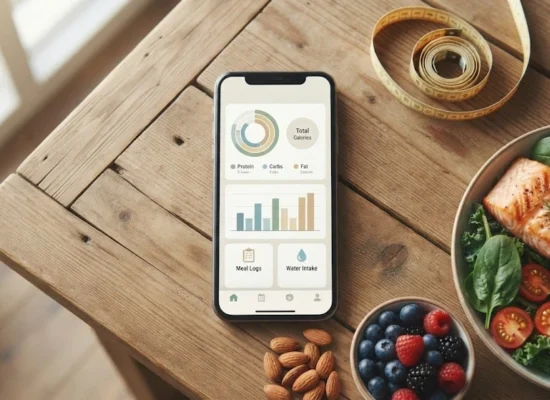
Take a photo of your plate. The AI automatically identifies the food, calculates macronutrients, and estimates the glycemic load.
-
Match your meals with your energy levels. If the AI shows a pattern of brain fog 60 minutes after eating a specific lunch, change that meal.
Step 4: Follow an AI-Driven Workout Plan
Do not follow generic internet workout routines. Use tools like Fitbod or ChatGPT (configured as an AI trainer) to analyze your daily readiness score.
-
If your Whoop or Oura ring says your recovery is at 85%, ask your AI app for a high-intensity strength training session.
-
If your recovery is at 35%, instruct the AI to generate a mobility and stretching routine to help your nervous system heal.
Advanced Biohacking: The Future of Lifespan Extension
Once you master the basics of sleep and exercise tracking, you can look into advanced health technologies that are reshaping medicine:
Continuous Glucose Monitors (CGMs) for Non-Diabetics
Devices like Dexcom or Abbott, which used to be exclusively for diabetic patients, are now widely used by biohackers. When paired with AI apps like Levels or Ultrahuman, they tell you exactly how a bowl of white rice versus a bowl of oats affects your unique body chemistry in real-time.
Epigenetic Testing & AI DNA Analysis
Companies like InsideTracker or Function Health analyze your blood biomarkers and DNA. They feed this massive chemical dataset into medical AI systems to predict which organs are aging the fastest and give you targeted supplement protocols to reverse that micro-aging.
Common Misconceptions About AI Biohacking
Because this field is evolving rapidly, several myths keep people from starting:
Myth 1: Biohacking is only for billionaires.
Reality: While people like Bryan Johnson spend millions a year, basic AI biohacking only requires a standard fitness tracker and free AI apps to optimize sleep, sunlight exposure, and walking habits.
Myth 2: The AI radiation from wearables is dangerous.
Reality: Modern bluetooth smart rings and trackers use extremely low-frequency, non-ionizing radiation that is thoroughly tested and completely safe for 24/7 use.
Myth 3: You have to become obsessed with numbers.
Reality: The goal of AI is to do the heavy lifting for you. You don’t need to stare at charts all day; you just need to read the daily summary notifications and make minor adjustments.
Summary: Your 3-Point Action Plan for Tomorrow
To summarize this extensive guide, here are the three simplest things you can do tomorrow morning to jumpstart your journey into AI biohacking for longevity:
-
Wear your smart device to sleep tonight: Ensure it fits snugly so it can read your heart rate volatility (HRV) accurately during the night.
-
Check your Morning Readiness Score: Let the AI tell you how recovered your body is before you check your emails or social media.
-
Adjust one habit based on data: If the app tells you that your late-night snacking ruined your deep sleep, commit to closing the kitchen fridge by 7:30 PM.
By letting artificial intelligence track and interpret your biometrics, you stop guessing about your health and start managing it like a well-oiled machine. Welcome to the future of wellness!
FAQs
Q1: Is AI biohacking safe for everyone?
Answer: Yes, basic AI biohacking—such as tracking your sleep, monitoring your daily steps, and analyzing your heart rate variability (HRV)—is completely safe for everyone. It simply helps you understand your body’s natural data. However, if you are planning to use advanced tools like Continuous Glucose Monitors (CGMs) or starting aggressive supplement protocols, it is always best to consult with a healthcare professional first.
Q2: What is the cheapest way to start AI biohacking?
Answer: You do not need expensive smart rings to start. The cheapest way is to use a standard budget fitness tracker (like a Fitbit or Xiaomi Mi Band) and connect it to free AI-driven health aggregators or apps like Gyroscopo. Even using ChatGPT to analyze your self-recorded daily energy levels and sleep hours is a great, free way to begin.
Q3: How does AI calculate my “Biological Age”?
Answer: AI calculates your biological age by analyzing complex biomarkers. Advanced AI longevity apps look at data from your blood tests (like inflammation markers, cholesterol, and liver enzymes) and compare them with global health databases. If your biomarkers are healthier than the average person of your age, the AI will show a lower biological age than your chronological age.
Q4: Can smart rings really detect if I am getting sick?
Answer: Yes, they can. Advanced smart rings like the Oura Ring or Ultrahuman Ring track minor fluctuations in your skin temperature and resting heart rate while you sleep. If the AI detects a sudden spike in body temperature combined with a sharp drop in your HRV, it often warns you about a potential illness or virus 24 to 48 hours before you actually feel any physical symptoms.
Q5: Will AI biohacking help me lose weight?
Answer: Definitely. AI removes the trial-and-error method from weight loss. By using AI nutrition tools, you can instantly see how your body reacts to different foods, track your calorie burn accurately based on your actual heart rate, and get dynamic workout plans that change daily according to how well your body recovered the night before.




[…] Once you have mastered the basics of AI-driven weight loss, you can further optimize your health and longevity by exploring the intersection of technology and biology in our complete guide to AI biohacking for beginners […]