



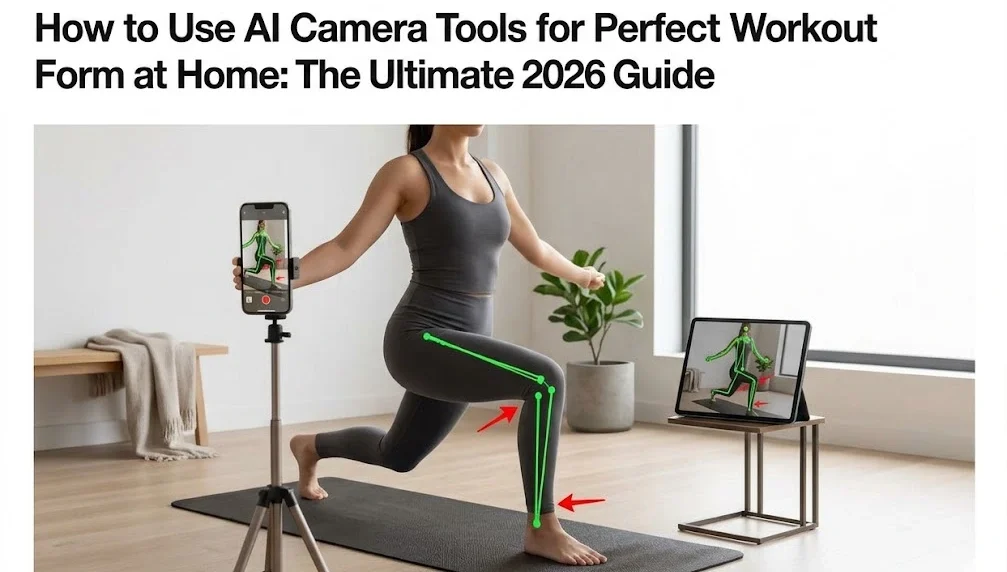
How to Use AI Camera Tools for Perfect Workout Form at Home: The Ultimate 2026 Guide
Working out at home has never been more popular, yet it carries one major risk. Without a human personal trainer watching your movements, it is incredibly easy to use the wrong posture. Poor mechanics during heavy or repetitive movements often lead to painful joint strains and severe injuries.
Table Of Content
- 1. The Hidden Danger of Home Workouts Without Guidance
- The Illusion of Correct Form
- Why Traditional Video Tutorials Fail
- 2. How Computer Vision Transforms Your Smartphone Camera
- Digital Skeletal Tracking
- Biomechanical Angle Analysis
- 3. Top AI Camera Tools Dominating 2026
- 1. Formax AI: The Specialized Posture Coach
- 2. Gymscore: The Gamified Fitness Tracker
- 3. SmartYoga Interactive
- 4. Step-by-Step Setup for Flawless AI Tracking
- Step 1: Optimize Your Environmental Lighting
- Step 2: Establish the Perfect Device Angle
- Step 3: Select Form-Fitting Workout Attire
- 5. Master Prompts to Integrate AI Form Data with ChatGPT
- The Posture Pattern Analyzer
- The Repetition Quality Optimizer
- 6. Real-World Case Studies: From Injury to Success
- Case Study A: Sarah’s Chronic Lower Back Relief
- Case Study B: David’s Rapid Strength Progression
- 7. Overcoming Technical Challenges & Limitations
- Dealing with Complex Angles
- Internet Latency and Processing Delays
- 8. What Does the Future Hold for AI Fitness?
- Frequently Asked Questions (FAQs)
- Do I need to buy an expensive camera to use these fitness apps?
- Can these applications store or leak my private workout videos?
- Will an AI camera tool work if I am working out in a crowded room?
- Can AI form correction completely replace a real human trainer?
- Is this software beneficial for elderly individuals performing physical therapy?
- Conclusion: Take Control of Your Health Safely
Fortunately, artificial intelligence has completely solved this dilemma in 2026. Advanced fitness applications now use your smartphone’s front-facing camera to analyze your skeletal alignment in real-time. These innovative systems act as digital trainers, correcting your posture instantly as you move.
Whether you are performing deep squats, heavy push-ups, or complex yoga poses, this comprehensive guide will show you exactly how to utilize AI camera tools to achieve flawless workout form right from your living room.
1. The Hidden Danger of Home Workouts Without Guidance
Gym memberships can be expensive, and traveling to a local fitness center requires valuable time. Because of this, millions of fitness enthusiasts prefer exercising in the comfort of their homes.
The Illusion of Correct Form
Many individuals place a large mirror in front of their workout mat, believing that watching themselves is enough to maintain a proper stance. However, human vision is highly limited when we are physically exerting ourselves. You cannot easily calculate the exact angle of your knees while balancing a heavy weight, nor can you check if your spine is perfectly neutral during a deadlift.
Why Traditional Video Tutorials Fail
Following pre-recorded workout videos on YouTube or premium fitness platforms is excellent for inspiration. Unfortunately, these videos only offer one-way communication. The screen presenter cannot look back through your display to tell you that your lower back is rounding. This structural disconnect often results in bad habits that damage your physical health over time.
2. How Computer Vision Transforms Your Smartphone Camera
To understand why this technology is so revolutionary, we must look at how artificial intelligence processes visual data. The specific field of science powering these fitness applications is known as Computer Vision.
┌────────────────────────────────────────────────────────┐
│               1. VIDEO INPUT CAPTURE                   │
│       Your smartphone camera records your movement.     │
└───────────────────────────▲────────────────────────────┘
                            │
┌───────────────────────────┴────────────────────────────┐
│               2. AI SKELETAL MAPPING                   │
│    The app places 17+ digital joints on your body.     │
└───────────────────────────▲────────────────────────────┘
                            │
┌───────────────────────────┴────────────────────────────┐
│               3. REAL-TIME CORRECTION                  │
│   Instant audio alerts fix your posture mid-exercise.  │
└────────────────────────────────────────────────────────┘
Digital Skeletal Tracking
When you stand in front of an AI fitness application, the software does not just look at you as a solid image. Instead, the AI algorithm instantly identifies your primary anatomical landmarks. It maps out precise digital points across your shoulders, elbows, hips, knees, and ankles. By connecting these coordinates, the software creates a dynamic virtual skeleton that updates sixty times per second.
Biomechanical Angle Analysis
Once the software establishes your digital skeleton, it applies strict biomechanical rules to your positioning. If you are doing a squat, the AI calculates the exact geometric angle between your thigh and your shin. If your knees lean too far inward, the system detects this deviation instantly because the digital coordinates shift away from the mathematically ideal path.
3. Top AI Camera Tools Dominating 2026
The marketplace for motion-tracking fitness software has matured immensely. Today, you do not need expensive, specialized hardware or wearable tracking suits. You simply need a standard smartphone or a tablet.
1. Formax AI: The Specialized Posture Coach
Formax AI focuses heavily on strength training and weightlifting mechanics. It offers a massive database of compound movements. The application excels at identifying minimal deviations in your spine and neck alignment, which are crucial for preventing long-term weightlifting injuries.
2. Gymscore: The Gamified Fitness Tracker
If you struggle with workout motivation, Gymscore is an ideal solution. This platform tracks your repetitions with absolute precision, meaning a rep only counts toward your daily score if your form is 100% perfect. Furthermore, it allows you to compete with remote friends in real-time safety challenges.
3. SmartYoga Interactive
Yoga requires immense precision and breath synchronization. SmartYoga Interactive uses advanced depth-sensing algorithms to ensure your weight distribution is balanced evenly across your limbs during complex balancing poses. Additionally, it speaks softly to guide your breathing as you hold challenging postures.
4. Step-by-Step Setup for Flawless AI Tracking
To get the absolute highest accuracy out of your AI personal trainer, your setup must be handled correctly. Poor lighting or bad camera angles will cause the software to miscalculate your joints.
Step 1: Optimize Your Environmental Lighting
Artificial intelligence requires a clear visual contrast to separate your body from the background. Therefore, ensure your workout space is brightly lit.
-
Avoid standing directly in front of a bright window, as this creates a silhouette effect.
-
Position overhead lights or lamps in front of you so your entire body is clearly illuminated.
Step 2: Establish the Perfect Device Angle
Prop your phone or tablet up against a stable surface at roughly hip height. Alternatively, utilizing a small, inexpensive tripod is highly recommended.
-
Lean the screen slightly so the camera can see your entire body from head to toe simultaneously.
-
Ensure you stand roughly six to eight feet away from the lens so that your hands do not disappear from the screen when you reach upward.
Step 3: Select Form-Fitting Workout Attire
Baggy hoodies and loose sweatpants hide the natural curves of your joints. Because the AI cannot see through fabric, loose clothing often leads to tracking errors. Instead, wear form-fitting activewear like leggings, compression shirts, or structured shorts. This allows the computer vision algorithm to lock onto your physical joints with maximum geometric precision.
5. Master Prompts to Integrate AI Form Data with ChatGPT
Many proprietary AI camera tools save your workout performance data as text metrics after you finish. You can easily feed these metrics into large language models like ChatGPT or Claude to get a deeply customized lifestyle and training plan.
Copy and paste these targeted prompts to maximize your physical progress:
The Posture Pattern Analyzer
If you notice that an app repeatedly tells you that your form is failing on a specific movement, use this prompt to discover why:
Role: Act as an Elite Biomechanics Specialist and Physiotherapist.

Context: My AI camera fitness application consistently alerts me that my heels are lifting off the floor whenever I reach the bottom phase of a barbell squat.

Task: Analyze this movement error. Provide 3 potential root causes related to muscle tightness or joint mobility. Outline a specific 5-minute daily stretching routine to correct this issue permanently. Use simple, encouraging language.
The Repetition Quality Optimizer
Use this prompt to alter your training volume based on how well you maintain your posture:
Role: Act as a Master Strength and Conditioning Coach.

Context: I am performing 4 sets of 10 repetitions of overhead dumbbell presses. According to my camera tracking data, my form score is 95% perfect for the first 7 reps, but drops to 60% on reps 8, 9, and 10 due to lower back arching.

Task: Redesign my set and rep structure so I can maximize my muscle building without exposing my lower back to injury. Explain the physiological reasoning behind your structural adjustment.
6. Real-World Case Studies: From Injury to Success
To see the true value of computer vision fitness technology, we can examine how real everyday athletes utilize these systems to alter their physical trajectories.
Case Study A: Sarah’s Chronic Lower Back Relief
Sarah, a thirty-four-year-old remote graphic designer, suffered from persistent lower back soreness after performing home workouts. She assumed her body was simply tired from exercise. However, after downloading an AI camera assistant, she discovered that her hips were unevenly tilting during simple lunges. By listening to the real-time audio cues of the app for three weeks, she corrected her pelvic alignment. Consequently, her chronic back pain completely vanished.
Case Study B: David’s Rapid Strength Progression
David wanted to build muscle using heavy kettlebell swings at home. He was terrified of injuring his spine, so he stayed with very light weights for months. Eventually, he set up a tablet running a live form correction application. The software provided him with the confidence that his hip hinge was anatomically perfect. Empowered by this objective data, David safely doubled his training weight over the next two months without experiencing a single day of negative joint strain.
7. Overcoming Technical Challenges & Limitations
While artificial intelligence is incredibly powerful, it is not entirely infallible. Users must understand the core limitations of consumer technology to prevent false readings.
Dealing with Complex Angles
Certain exercise movements require you to lie completely flat on the floor facing away from your device screen. In these specific scenarios, checking a visual display becomes impossible. To bypass this limitation, always choose an application that features robust audio feedback. High-quality tools will use distinct sound tones or clear spoken phrases like “lower your hips” so you can adjust your body without craning your neck to look at the glass display.
Internet Latency and Processing Delays
If you are running advanced software on an older smartphone model, you may experience a slight processing lag. The app might tell you to fix your form two seconds after you have already completed the repetition. To fix this, close all background processing applications running on your device before beginning your training session. This frees up maximum RAM, allowing the computer vision architecture to process your video frames smoothly.
8. What Does the Future Hold for AI Fitness?
The evolution of automated health tracking is moving at an exceptional pace. By looking at current developmental pipelines, we can easily see that the line between commercial gym equipment and home training will disappear completely over the next several years.
Soon, you will not even need to look at a small phone screen. Augmented Reality (AR) smart glasses will overlay digital skeletal target lines directly onto your physical environment. As you lift, you will see a perfect virtual holographic trainer performing the movement directly alongside you, showing you exactly how to match their pacing, depth, and structural stability.
Furthermore, these systems will soon connect directly to automated grocery delivery systems. If your AI camera detects that your muscle recovery speed is slowing down based on your movement velocity, it will automatically adjust your weekly meal delivery to include more protein-dense foods.
Frequently Asked Questions (FAQs)
Do I need to buy an expensive camera to use these fitness apps?
No, you absolutely do not. The standard built-in front camera on any modern smartphone or tablet released over the last few years is more than powerful enough to handle complex skeletal mapping.
Can these applications store or leak my private workout videos?
Most premium, privacy-focused AI fitness applications process your visual data directly on your local device. This technical methodology is known as Edge Computing. Because the video frames are analyzed locally in real-time, the raw video footage is never uploaded to an external cloud server, keeping your home environment completely private.
Will an AI camera tool work if I am working out in a crowded room?
Most modern tracking tools feature specific user isolation settings. When you begin your workout, you stand still for five seconds so the AI can lock onto your specific body dimensions. Once this calibration is complete, the software will ignore other family members or pets walking around in the background.
Can AI form correction completely replace a real human trainer?
For ninety percent of regular fitness enthusiasts looking to stay healthy, burn fat, and lift weights safely, AI tools are an exceptional, low-cost replacement. However, if you are an elite professional athlete preparing for a high-level competition, a human coach is still valuable for emotional support and nuanced psychological strategy.
Is this software beneficial for elderly individuals performing physical therapy?
Yes, it is incredibly beneficial. Many physical therapy patients require highly specific joint angles to rebuild muscle tissue safely after surgery. AI camera systems ensure they do not exceed their safe ranges of motion, preventing accidental re-injury during recovery.
Conclusion: Take Control of Your Health Safely
Building a strong, healthy body should not require you to risk joint damage or unexpected injuries. Technology has democratized elite personal coaching, putting an advanced biomechanics specialist right inside your pocket.
Do not wait until you experience a painful workout strain to fix your posture. Download a modern computer vision tool today, set up your device using the steps outlined above, and allow artificial intelligence to protect your longevity. By mastering your body mechanics now, you are building a pain-free foundation that will keep you strong, functional, and active for decades to come.
If you want to discover more ways that artificial intelligence can optimize your daily lifestyle and physical health routines, read our complete guide on how to build a comprehensive AI SOP Library for Small Business, or check out our master overview regarding advanced automated productivity.







[…] on Movement Quality: As mentioned in our guide on AI Camera Tools for Workout Form, always use technology to ensure you are moving correctly. Even during low-intensity phases, the […]